

Martin Johnson Heade
33.7 x 66 cm
Further images
“When Heade was born, Benjamin West was dying in London. When Heade died, Gertrude Stein was setting up house in Paris,” remarked critic John Canaday in his 1969 New York Times review of the Whitney Museum of American Art’s solo exhibition of Martin Johnson Heade. [1] For Canaday, the sweep of Heade’s eighty-five-year lifespan paralleled the emergence of a confident, self-determined American art. Although long considered a loner who was independent in temperament and eclectic in subject matter, Heade participated in what Canaday called the “declaration of independence” of American painting as it matured beyond its colonial traditions. [2]
During his lifetime, Heade supported himself through his art but remained largely overlooked by critics and collectors. As art historian and Heade expert Theodore Stebbins observed in 1969, Heade’s independent temperament and unconventional approach had placed him “out of place in his time.” Stebbins asserts that only later could his body of work be properly appreciated. [3] Today, Heade is recognized as a central figure of Luminism, admired for his meticulous handling of light and atmosphere and for a body of work notable for its thematic consistency. His sustained engagement with coastal salt marshes, beginning in 1858 or 1859 and continuing for more than three decades, stands as his most distinctive contribution to American art. These marsh scenes, which account for roughly one-fifth of his output, reveal Heade at his most contemplative. Unlike the dramatic wildernesses prized by the artists of the Hudson River School, Heade’s marshes dwell on the quieter, slower rhythms of nature, evoking solitude, transience, and the psychological resonance of twilight. In this way, his approach aligns with the American Transcendentalists, whose influence was at its height in New England during Heade’s early career.
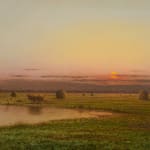
Sunset on the Rowley Marshes exemplifies Heade’s distinctive, introspective vision. The composition unfolds in an exaggerated horizontality: a low horizon line; an expansive sky lit by the fading glow of a rose-tinted sunset; and a serpentine river guiding the viewer’s eye gently through the landscape. Haystacks pepper the marsh grass in irregular intervals, giving the scene both structure and a subtle trace of human presence at the edge of nature. Small in scale and minutely finished, the painting carries the quiet intensity associated with Transcendentalist Ralph Waldo Emerson’s famous assertion: “I become a transparent eye-ball. I am nothing; I see all; the currents of the Universal Being circulate through me; I am part or parcel of God.” [4] Although it is not known whether Heade consciously intended these works as visual counterparts to Transcendentalist thought, their affinity with the movement’s spiritual understanding of nature is unmistakable. [5] Despite its precise detail, the painting, like many of Heade’s marsh views, is not site-specific. Rather than depict a particular location, Heade sought to capture the essential character of marshland itself. As Stebbins notes, titles such as “Rowley Marshes” are often imaginative, nodding to Massachusetts locales Heade knew in the 1860s, while this painting was likely executed from studies made in New Jersey or Florida. [6]
Through works such as Sunset on the Rowley Marshes, Heade forged a language of American landscape painting that was neither heroic nor sentimental but quietly revelatory. His marshes, suffused with atmosphere and introspection, stand apart from the larger currents of nineteenth-century American art while engaging a transcendental understanding of humanity’s relationship to the natural world. Their power lies in their restraint: vast space, delicate light, and minute detail coalesce into a painting grounded in place and elevated beyond. Today, Heade stands among America’s most original painters, and his marsh scenes remain enduring meditations on nature’s subtle, ever-changing beauty and our relationship to it.
[1] John Canaday, “M.J. Heade: American Loner,” New York Times, November 16, 1969, p. 25
[2] Canaday, p. 25
[3] Theodore E. Stebbins, Jr., Martin Johnson Heade, University of Maryland, 1969, unp.
[4] Ralph Waldo Emerson, Nature, Boston: James Munroe and Company, 1836
[5] Tim Barringer, “The Course of Empires: Landscape and Identity in America and Britain, 1820-1880,” in Andrew Wilton and Tim Barringer, American Sublime: Landscape Painting in the United States 1820-1880, London: Tate Publishing, 2002, p. 57
[6] Theodore E. Stebbins, Jr., The Life and Work of Martin Johnson Heade (New Haven, Connecticut: Yale University Press, 1975), p. 279, no. 343
Provenance
The artist;
Private collection, Colorado;
[Vose Galleries, Boston, Massachusetts, 1968];
[Hirschl & Adler Galleries, New York, 1968-71];
Private collection;
[Berry-Hill Galleries, New York];
Elizabeth Gosnell, New York;
[Avery Galleries, Bryn Mawr, Pennsylvania];
Private collection, until the present
Exhibitions
Hirschl & Adler Galleries, New York; Dallas Museum of Fine Arts, Texas, The American Scene: A Survey of the Life and Landscape of the Nineteenth Century, October 29-November 22, 1969, no. 34, illus., as Salt Hay on the Rowley MarshesM. Knoedler & Co., New York, What Is American in American Art: an exhibition in memory of Joseph B. Martinson for the benefit of the Museum of American Folk Art, 1971, pp. 35, 62, no. 70, illus. p. 62, as Salt Hay on the Rowley
Dallas Museum of Fine Arts, Texas, The Romantic Vision in America, October 9-November 28, 1971, no. 43
Berry-Hill Galleries, New York, American Paintings IV, 1986, pp. 34-35, illus.
Literature
C. Robbins, The Romantic Vision in America, Dallas: Dallas Museum of Fine Arts, 1971, no. 43, illus.Theodore E. Stebbins, Jr., The Life and Work of Martin Johnson Heade, New Haven, Connecticut: Yale University Press, 1975, p. 279, no. 343, illus., as dated c. 1890-1900
Theodore E. Stebbins, Jr., The Life and Work of Martin Johnson Heade: A Critical Analysis and Catalogue Raisonné, New Haven, Connecticut: Yale University Press, 2000, p. 263, no. 251, illus.


The gallery is open Monday through Friday, 10:00 am to 6:00 pm. We are located at 390 Broadway, 3rd Floor, New York, NY 10013.
Subscribe to our mailing list to receive updates from the gallery
* denotes required fields
We will process the personal data you have supplied in accordance with our privacy policy (available on request). You can unsubscribe or change your preferences at any time by clicking the link in our emails.